
Metal Labels Exporter for Custom Durable Tags
2026-09-19
A metal tag that fades or falls off isn’t just a replacement cost—it’s a failure waiting to happen. That’s why sourcing custom durable labels demands a different kind of exporter. Kingming has spent years engineering tags that survive heat, chemicals, and rough handling while keeping critical information readable. If you’re tired of off-the-shelf options that can’t match your specs, here’s what to expect from a supplier that treats durability as the baseline.
Engraved to Endure, Not Just to Identify
Most markings fade, chip, or get scratched away within a few years. That’s not what this is about. An engraving that’s meant to endure carries weight—every groove cut into the metal or wood holds a deliberate choice. It isn’t just a name or a number; it’s a promise that something mattered enough to be made permanent.
Think of the difference between a sticker with a serial code and a hand-tooled inscription on a watch back or a memorial plaque. One gets peeled off and replaced. The other becomes part of the object’s skin. We lean toward the second kind, because objects outlive us, and the marks we leave should be able to tell a story long after the context is gone.
So whether it’s a coordinate, a date, a signature, or a short line only you understand, the point is never just to identify. It’s to let the engraving age with the thing it’s on—collecting scratches, polishing unevenly, becoming something closer to memory than to text.
Custom Shapes That Break the Rectangle Habit
Most interfaces fall into a predictable grid of rectangles—cards, buttons, modals, all sharp corners and straight lines. Breaking that habit starts with custom shapes that feel intentional rather than decorative. A gently curved blob for a profile avatar, a diagonal cut on a hero section, or a hexagonal icon set can make a layout feel alive without sacrificing usability.
The key is to tie the shape to the content's purpose. A circular progress ring does more than look different; it conveys completion at a glance. An irregular organic form behind a testimonial can soften the tone and draw the eye. When custom shapes replace default geometry, the entire page stops feeling like a template and starts feeling designed.
Anodized, Etched, and Ready for the Real World
Most finishes look great in a studio light and fall apart the first time they slide across a concrete floor. That's not what's happening here. The base is 6061 aluminum, hard anodized until the surface becomes a dense, scratch-resistant layer that doesn't flake or peel. You'll notice the edges have a slight chamfer that catches light without feeling sharp, and the etch isn't just printed on—it's burned into the oxide layer, so it won't rub off after a few weeks in a pocket with keys and coins.
The etching process gets tuned for depth, not just contrast. Too shallow and the markings disappear under a thumb; too deep and the anodized layer gets compromised. We landed on a depth that keeps the texture tactile enough to find by feel but smooth enough that it doesn't collect grime. After anodizing and etching, every piece goes through a sealed rinse and a quick tumble with ceramic media to knock down any microscopic high spots. That extra step means you're not getting a showpiece—you're getting a surface that already knows how to take a hit.
The real test isn't the spec sheet. It's six months of sliding into a bag, getting dropped on gravel, and being left in a hot car. The color doesn't turn chalky, the edges don't chip, and the etched marks stay legible. That's the whole point of this finish: not to look untouched, but to look honest after everything you throw at it.
From Prototype to Pallet: How We Ship Worldwide
Every product we ship starts as a rough idea scribbled on a whiteboard or a quick sketch on a napkin. We don't wait for perfection; we build small, test fast, and let real feedback shape the next iteration. Prototypes live in our workshop for days, not months, getting bent, dropped, and rebuilt until they feel right in your hands.
Once a prototype earns its place, we move to sourcing materials that can handle the journey from our door to yours. No fragile parts, no over-engineered packaging that ends up in a landfill. We use recycled pulp inserts, reusable straps, and boxes that fit like a glove — because a broken product on arrival is a broken promise.
From our loading dock to freight ships, cargo planes, and local couriers, every pallet is stacked to survive rough seas and rougher handling. We track each shipment, learn from every delay, and adjust routes quarterly. Whether you're in Berlin, Brisbane, or Boise, the box on your porch is the same one we'd hand you if you walked into our workshop.
When Your Equipment Needs a Nameplate That Fights Back
Some environments chew up standard nameplates and spit them out as unreadable scraps. Chemical washdowns, abrasive dust, UV exposure, or a forklift's careless nudge can turn a crisp data plate into a blank metal square within months. That's when the label stops being a passive identifier and becomes the weakest link in your maintenance chain.
A nameplate that fights back doesn't just sit there hoping for the best. It's built from materials that shrug off solvents, scratches, and thermal shocks. Think anodized aluminum with subsurface graphics that can't be rubbed away, or ceramic-coated tags that laugh at a pressure washer. The text stays legible because it's physically part of the surface, not printed on top of it.
The real test comes when someone tries to remove or alter it. Ordinary adhesive labels peel off with a heat gun. Fighting-back nameplates use tamper-evident adhesives or mechanical fasteners that leave obvious destruction behind. If the plate finally does get pried off, it leaves a ghost image or a destroyed mounting hole, so nobody can claim they didn't know which pump was which.
Small Batch or Bulk? Neither Scares Our Floor
We've laid floors in a 60-square-foot pantry and a 60,000-square-foot warehouse, and the process feels oddly similar. The material ordering doesn't blink at a few extra pallets, and our crew doesn't need a pep talk when the square footage doubles. Small jobs get the same attention to joint lines and threshold transitions as the big ones—maybe more, because every inch is visible.
On the bulk side, we keep a rolling stock of core products so a last-minute expansion or a phased build-out doesn't stall. We'll stage deliveries in waves, work around your operating hours, and still hit the same flatness tolerance across a 200-foot run. No special pleading, no "that's too small" or "that's too big." Just flooring that shows up ready to work.
FAQ
We work with aluminum, stainless steel, brass, and anodized finishes, selected for corrosion resistance and long-term readability.
We handle both low-volume pilot runs and large export orders, so you can start small and scale once the design is confirmed.
We use UV-resistant printing and etching methods, plus optional protective coatings that hold up under sun, rain, and temperature swings.
Yes, our team helps with sizing, logo placement, and barcode or serial number formatting before production begins.
You can include text, logos, QR codes, barcodes, serial numbers, and safety symbols, depending on the space and tag size.
Each order is packed in moisture-resistant layers and reinforced boxes, with barcode labels for easy tracking during export.
Yes, they resist chemicals, abrasion, and high heat, making them common in oil and gas, manufacturing, and outdoor equipment industries.
Most orders ship within 10-15 business days after artwork approval, with expedited options available for tight deadlines.
Conclusion
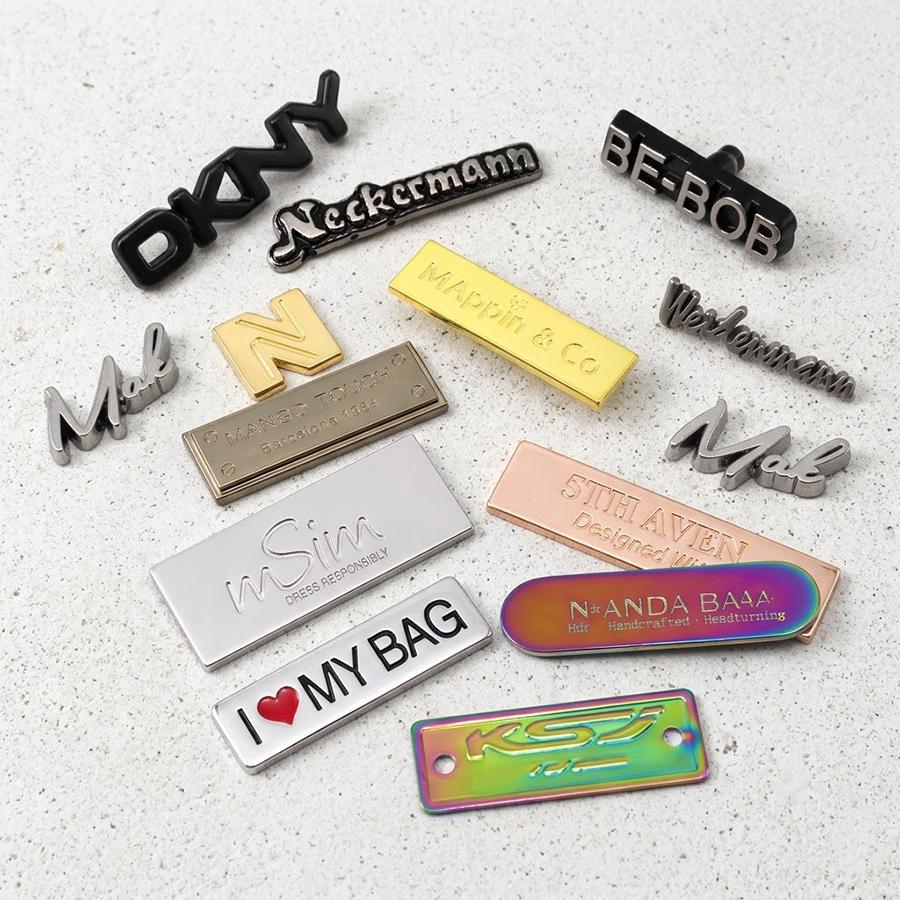
When you need a tag that will outlast the machine it's bolted to, standard printed labels simply don't cut it. Our metal labels are engraved deep into stainless steel or aluminum, then anodized or chemically etched so the markings become part of the surface rather than sitting on top. This isn't just for identification—it's for survival in places where paint scratches off and plastic warps. We regularly cut custom shapes that have nothing to do with the usual rectangle: contoured badges, circular serial plates, even irregular outlines that match a product's housing. The result is a nameplate that looks like it belongs, and more importantly, one that fights back against abrasion, solvents, salt spray, and UV exposure.
The other side of the business is just as important: we don't flinch at a one-off prototype or a container-load order. The same floor that runs a handful of laser-etched samples in the morning can shift to thousands of stamped and anodized tags by the afternoon. Shipping is handled from our dock to yours—whether that's a single padded envelope to a design studio or a pallet headed for an overseas assembly line. We've built the workflow around small batch agility and bulk consistency, because some clients need test tags for a new product launch while others need a steady supply for years of production. Either way, the tags leave here ready for real-world abuse, not just for show.
Contact Us
Contact Person: Jamie Zeng
Email: [email protected]
Tel/WhatsApp: +86 13728219269
Website: https://www.kmhardware.com